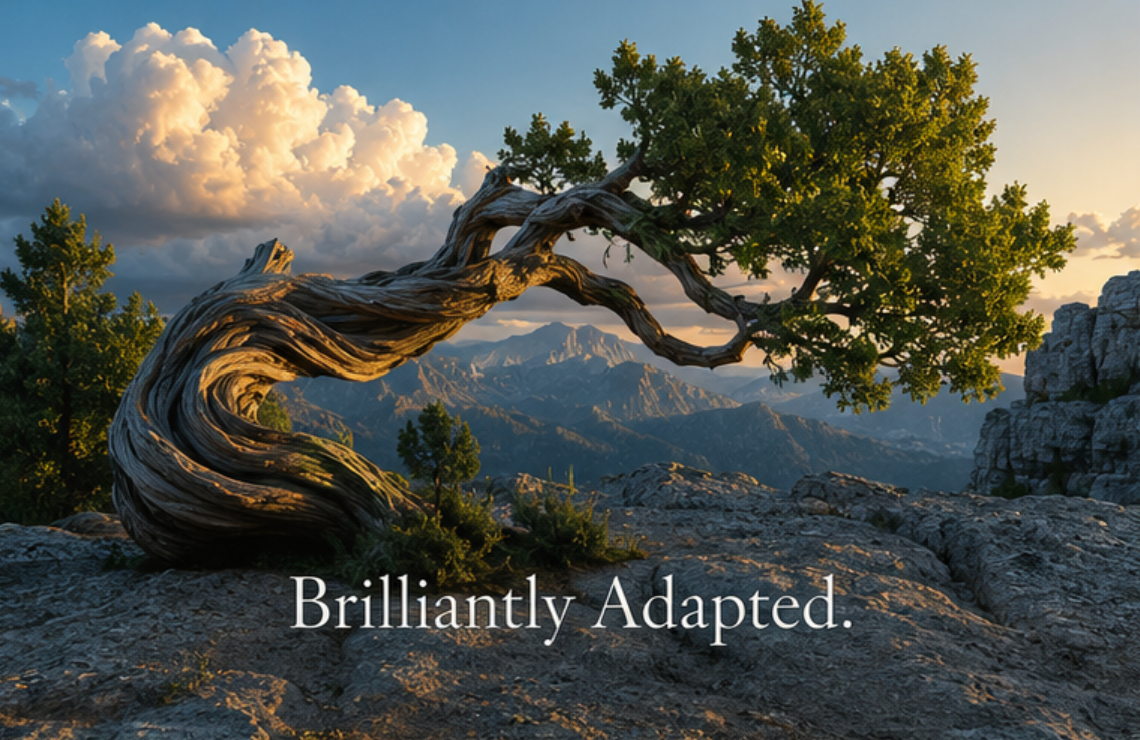
We’re Not Broken—We’re Adapted
“What if your symptoms are not signs of dysfunction—but evidence of how intelligently you adapted?”
I often hear people describe themselves as “broken” or “dysfunctional.” And I understand why—it can feel that way when you’re anxious, shut down, overwhelmed, or caught in patterns you don’t fully understand.
But clinically, I don’t experience people that way.
I experience them as adapted.
Each of us comes into the world with a certain sensitivity—biological, emotional, relational. And over time, we develop ways of organizing ourselves that help us feel safe enough to function in the environments we’re in.
Some of those patterns are conscious. Many are not.
What we often call “symptoms” are, in many cases, the downstream effects of those adaptations.
It’s easy to begin thinking about behaviors we aren’t proud of as evidence that something is wrong with us—something that needs to be fixed. But if we reflect back on childhood, we can see that children organize around safety almost instinctively. The nervous system learns what it needs to survive long before the conscious mind understands what’s happening.
Over time, adaptations can begin to feel like identity.
They can take many forms: hyper-independence, people-pleasing, overachievement, vigilance, perfectionism, emotional numbing, and many others.
These patterns are often survival strategies long before they feel like personality.
And over time, our adaptations don’t just shape the mind—they shape the body, our relationships, and the way we move through the world.
There’s a Japanese philosophy called Kintsugi—the art of repairing broken pottery with gold. The cracks aren’t hidden; they become part of the story.
I’ve always loved that image.
But increasingly, I think many people were never “broken” in the way they fear they are.
Often, what we’re seeing are the marks of adaptation—the places where a person learned to survive.
So instead of asking, “What’s wrong with me?” perhaps a more compassionate question is:
“What did my system learn it needed to do to feel safe?”
Survival strategies are not character flaws. They are evidence of how remarkably we adapted in order to survive.
Healing begins when we slow down enough to notice the pattern instead of automatically becoming it.
Healing is a way of moving through the world with greater flexibility, awareness, and choice.
The invitation is to create enough pause to notice what has become automatic.
Because we can’t recognize these patterns while we are unconsciously living them out.
Warmly,
Dr. Eva Altobelli
Share this article

Written by : Dr.Eva
Follow us
Latest articles
October 27, 2026
October 27, 2026
October 27, 2026